
Dealing with AI in Higher Education – How to go from theory to practice?
From AI anxiety to academic practice
Generative AI is already part of academic work. The practical question is how universities can guide its use while preserving intellectual effort, transparent authorship and credible assessment.
Anders Randler & Raine Isaksson · Uppsala University, Campus Gotland · Case-informed synthesis
From institutional resistance to a transparent, human-led bridge into practice.
The institutional question
AI entered education faster than institutions could plan for it
Prohibition leaves actual practice hidden. Passive acceptance leaves it unguided. The paper organises a response around three questions.
01
Adapt
How can teachers and students respond when AI tools change faster than ordinary planning cycles?
02
Integrate
How can AI be incorporated transparently without surrendering academic judgment?
03
Protect
How should education protect cognitive development and verify independent understanding?
What the evidence suggests
Access alone is not the intervention
A 19-study meta-analysis cited by the paper reports markedly different outcomes depending on whether educators scaffold GenAI use.
The educational variable is not simply whether students use AI. It is whether educators design the interaction, frame its purpose and require students to evaluate what the system produces. Randler & Isaksson, 2026; Liu et al., 2025
g = 1.426With explicit teacher scaffolding
g = 0.077Without structured support
Reported overall effect: g = 0.683. Effect sizes describe the cited evidence base, not an expected result for every course.
The three-pillar model
A departmental model for responsible adaptation
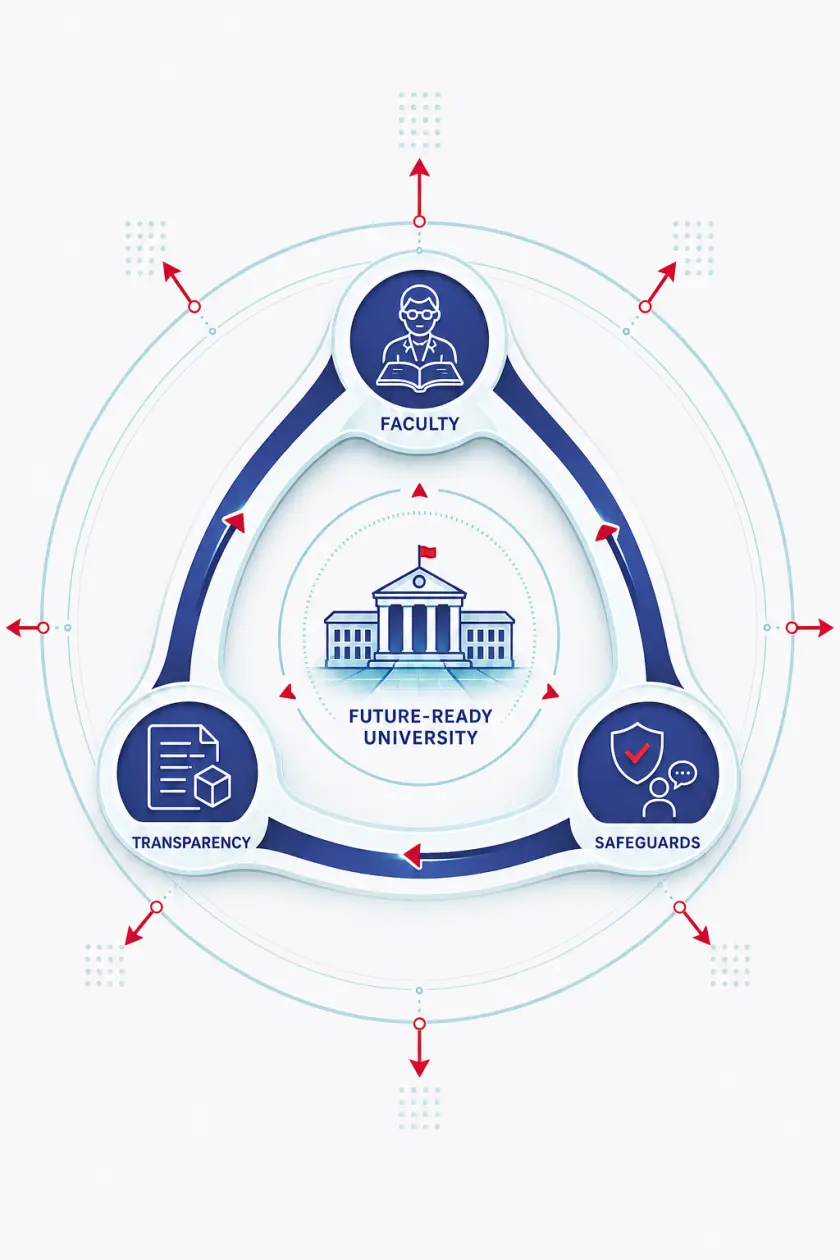
The model works as a dependency chain. Faculty competence enables transparent integration; assessment protects the learning that integration is meant to support.
The three elements must develop together.
01
Foundation
Build faculty AI literacy first
Educators need technical, pedagogical and ethical fluency to recognise unreliable output, design meaningful AI-supported tasks and explain their decisions to students.
In practice: provide hands-on development connected to real teaching, research and administrative work.
02
Application
Make AI use visible and teachable
Replace “shadow use” with explicit syllabus guidance and credit-bearing AI literacy education. Students should learn to question, edit, source-check and disclose—not merely prompt.
In practice: state where AI is required, permitted, restricted or excluded, and connect each decision to learning outcomes.
03
Safeguard
Protect the effort that produces learning
AI can improve a visible product while bypassing the cognitive work that makes knowledge durable. Learning may be open and AI-supported; assessment must still verify individual understanding.
In practice: combine documented AI-supported work with oral, practical or process-based evidence of reasoning.
Theory into practice · Campus Gotland
Two learning tracks, one shared foundation
The departmental case combines a student course with targeted faculty development. It is an implementation example, not a controlled trial.
For students · 5 credits
Introduction to Generative AI and its Applications 1TG334
Understand & explainFunction, limitations, training bias and terminology.
Apply & constructText, images and media through multimodal prompting.
Reflect & analyseEthical, social, legal and copyright implications.
35 campus students102 distance enrolments55 active distance participants52 distance passes
For faculty & researchers · 3 modules
AI Literacy for Effective Teaching, Research and Administration
01 Generative AI in education and administration
02 Generative AI in research, including source-grounded work and RAG
03 Ethical and local AI: privacy, bias, integrity and sensitive data
Three hands-on modules of three to five hours each establish a shared vocabulary for institutional practice.
Preserving desirable difficulties
Support the process. Verify the understanding.
“AI should be open in learning and accountable in assessment.”
Open
Learning phase
AI-supported exploration
Students may use AI for explanations, critique, literature exploration, debugging and alternative perspectives. Use is documented, discussed and source-checked.
Verified
Assessment phase
Independent understanding
Students demonstrate what they understand through structured oral discussion, problem solving, practical work or other direct evidence.
Important: oral assessment is not presented as a universal replacement for written work. Validity and equity require structured questions, explicit rubrics, examiner calibration, accommodations and complementary evidence.
Evidence boundary
A roadmap, not a completed trial
The paper combines research synthesis and policy guidance with early experience from one department. It does not report a controlled evaluation of the local initiatives.
The paper also discloses how AI supported research, reading, drafting and refinement—putting its own transparency principle into practice.
01One departmental case in the Swedish higher-education context
02Early local outcomes that are largely qualitative
03Oral-assessment workload in large cohorts
04Equity, accessibility and examiner-bias concerns
05GDPR, paid access and vendor dependence
06Risk of cognitive deskilling through over-normalised assistance
About the author
Anders Randler
University lecturer at Uppsala University, Campus Gotland, teaching mathematics and artificial intelligence.
For more than a decade, he has also educated teachers through his role as an Apple Distinguished Educator. His work connects technological change with the practical design of teaching, learning and assessment.
The paper is co-authored with Raine Isaksson of Uppsala University.