Act 01 · Slides 1–3
Disruption and the research questions
Pitch argument
Generative AI bypassed the ordinary channels through which universities evaluate and adopt technology. The false choice is prohibition or uncritical adoption.
Article grounding
The paper reframes the response through three questions: how to adapt, integrate and protect. It connects AI literacy, transparent guidance and assessment design rather than treating misuse as an isolated conduct problem. Randler & Isaksson, 2026
Critical reading
This is the pitch’s essential framing move: it relocates the debate from individual misconduct to institutional design. Its usefulness lies in opening a programme of work, not in resolving every policy choice.
AdaptHow do institutions respond at the speed of change?
IntegrateHow does AI become visible and teachable?
ProtectHow is independent understanding preserved?
Act 02 · Slides 4–5
Evidence, method and transparent AI use
Pitch argument
Broad evidence and policy guidance can be translated through a local departmental case. The paper’s own AI use is disclosed as an example of the transparency it advocates.
Article grounding
The synthesis draws on systematic reviews, meta-analyses and guidance from UNESCO and the OECD, then examines initiatives in the Division of Quality Science at Campus Gotland.
Critical reading
The design can generate a transferable model, but it cannot show that the local courses caused measurable improvement. The case is an implementation example and basis for evaluation—not controlled proof.

Act 03 · Slides 6–9
One department, two educational interventions
Pitch argument
Students and faculty need different learning tracks built on a common vocabulary. Student literacy should be credit-bearing; faculty development should be hands-on and connected to real work.
Article grounding
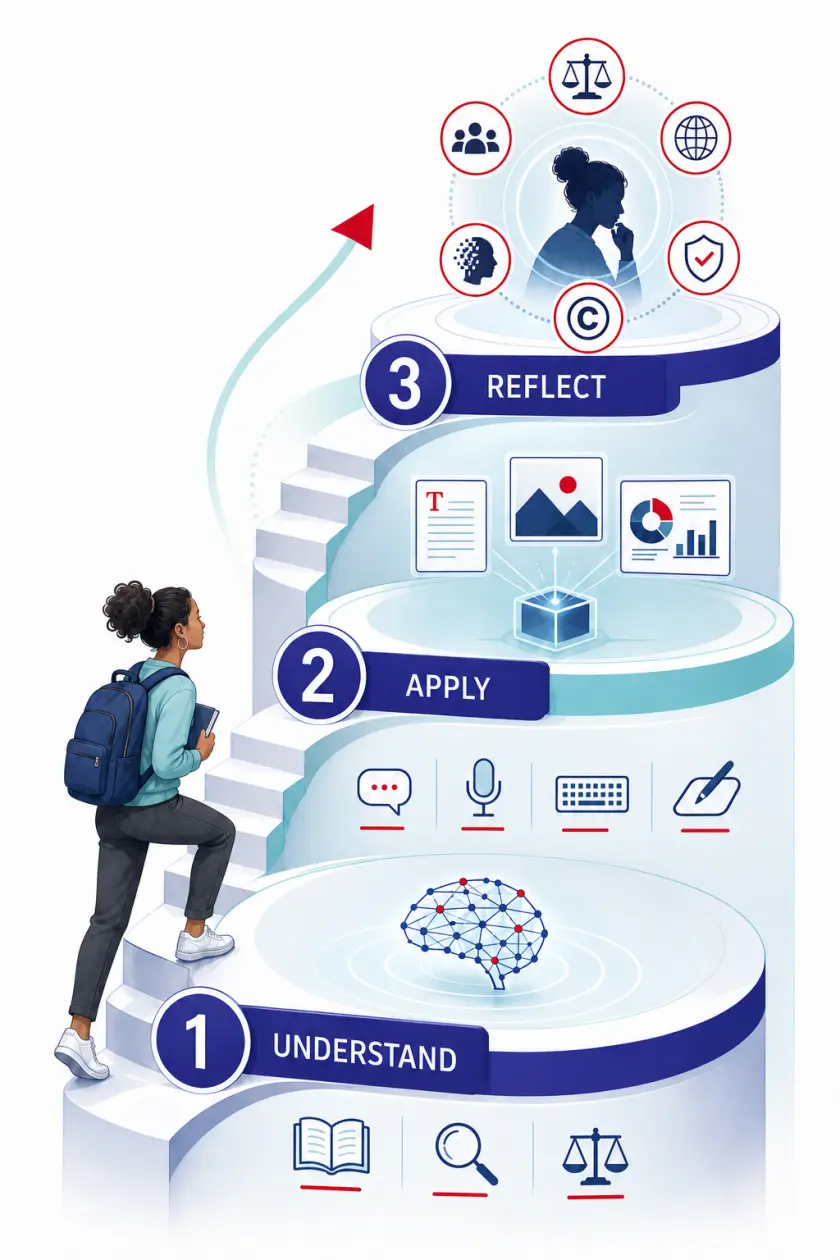
The five-credit course 1TG334 moves through understand, apply and reflect. Three faculty modules address education and administration, research and RAG, then ethics and local AI.
Critical reading
Participation figures describe reach, not causal impact: 35 campus students; 102 distance enrolments, 55 active participants and 52 passes. Faculty outcomes are early and largely self-reported.
Implication for practice
Start with a shared baseline, but evaluate the two tracks separately: student learning, faculty practice and organisational capacity are different outcomes.
Act 04 · Slides 10–13
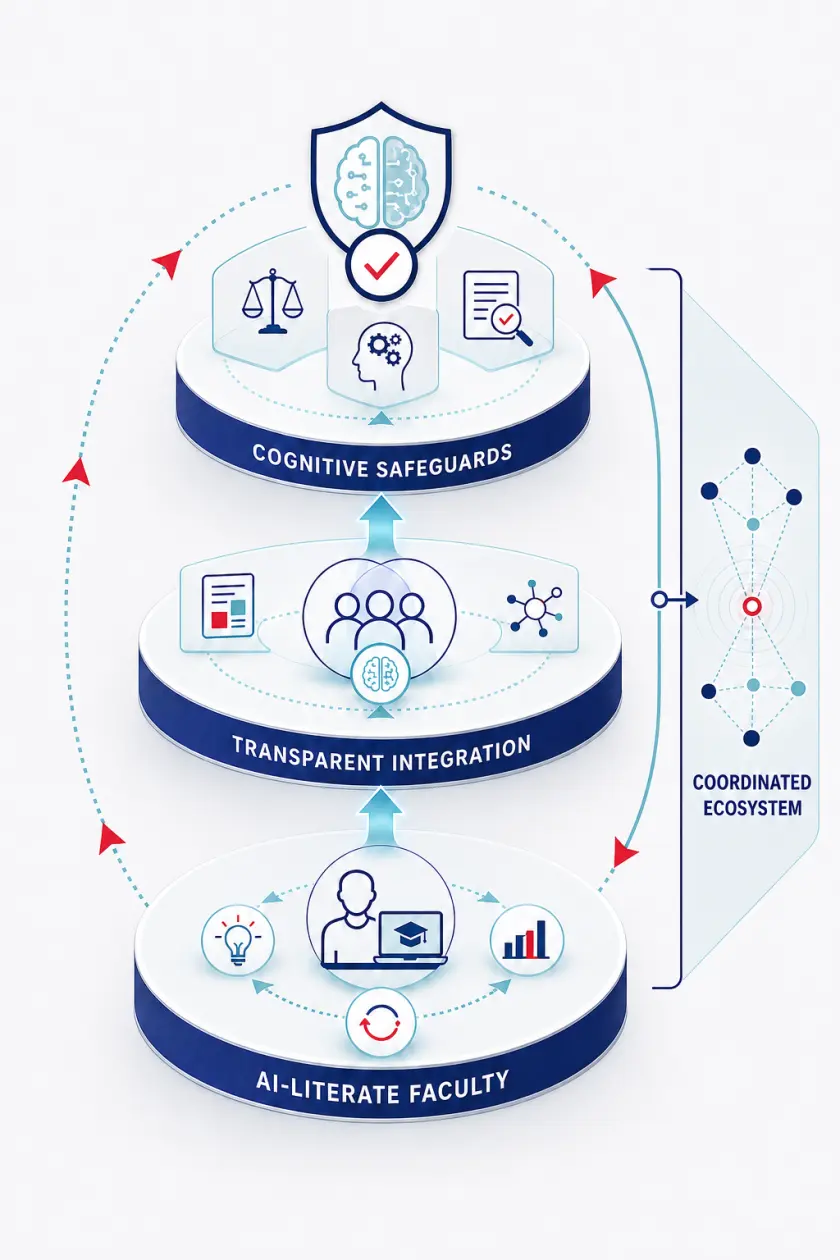
The three pillars as a dependency chain
- Foundation
AI-literate faculty
Educators connect technological capability with disciplinary knowledge, pedagogical purpose and ethical judgment.
- Application
Transparent integration
Explicit syllabus guidance and student education replace hidden use with observable learning processes.
- Safeguard
Assessment reform
Direct evidence of reasoning verifies whether students can explain, apply and defend the work independently.
Pitch argument
Isolated AI initiatives are insufficient. The pillars become an operating model only when educator competence, curriculum design and assessment develop together.
Article grounding
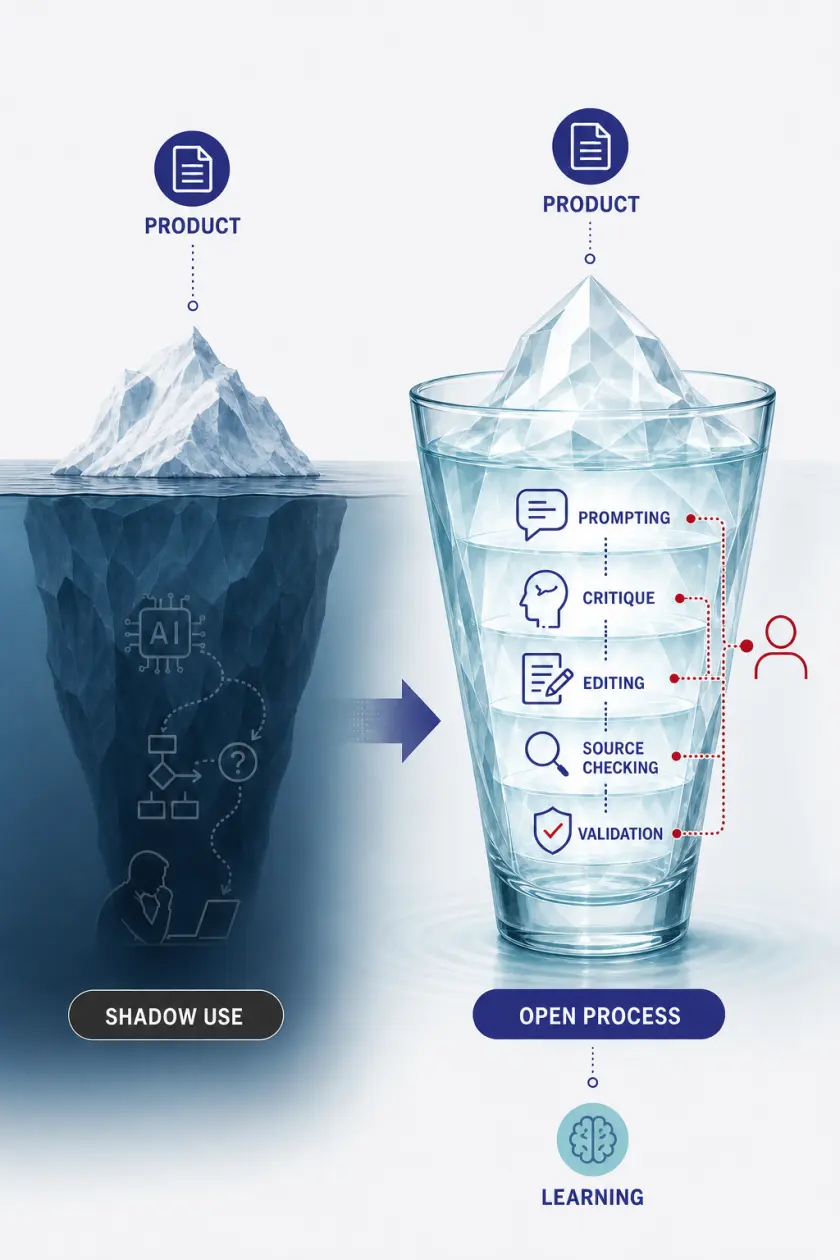
The paper contrasts hidden “shadow use” with an open process: prompting, critique, editing, source checking and validation. Transparency turns AI use into something that can be taught and examined.
Critical reading
The model is strongest as a sequence, not three interchangeable recommendations. Transparent student use cannot be guided without faculty competence, and open learning cannot remain credible without dependable assessment.
Act 05 · Slides 14–15
Integrated model and evidence boundaries
Pitch argument
Decouple learning from examination: allow open AI-supported exploration during learning, then require direct evidence of understanding.
Article grounding
Suggested formats include a portfolio followed by a structured 15–20 minute oral discussion, group presentations with individual questions and progressive oral checks across a programme.
Critical reading
Oral assessment is not a universal substitute for written work. Workload, disability, anxiety, language and examiner bias require rubrics, calibration, accommodations and complementary evidence.
Act 06 · Slides 16–17
Conclusions and next actions
Pitch argument
Departments should move from tool debates to coordinated choices about competence, curriculum and credible evidence of learning.
Article grounding
The paper proposes an adaptive model: build faculty literacy, make integration explicit and pilot assessment forms that preserve independent reasoning.
Critical reading
The value lies less in prescribing one universal solution than in giving departments a coherent starting point for pilots, evidence gathering and revision.

What remains unresolved
A model becomes credible when its tensions stay visible
A 15–20 minute oral component may be feasible in some courses and costly in others.
Oral performance can be affected by disability, anxiety, language and examiner bias.
Cloud services raise privacy, GDPR, paid-access and vendor-dependence questions.
Constant assistance may erode the productive struggle the model seeks to protect.
Local initiatives have not yet been evaluated against defined performance measures or a control group.
Policy and course design need review cycles that can respond to rapidly changing tools.
Questions for Naples
Move the discussion from tools to institutional choices
- What baseline AI literacy should every educator possess?
- Where should AI use be required, permitted, restricted or excluded—and why?
- What evidence of student reasoning remains credible when polished output is easy to generate?
- Which oral, practical or process-based assessments could be piloted without creating new inequities?
- What measures would show improved learning rather than faster task completion?
- How often should policy and course design be reviewed as tools change?